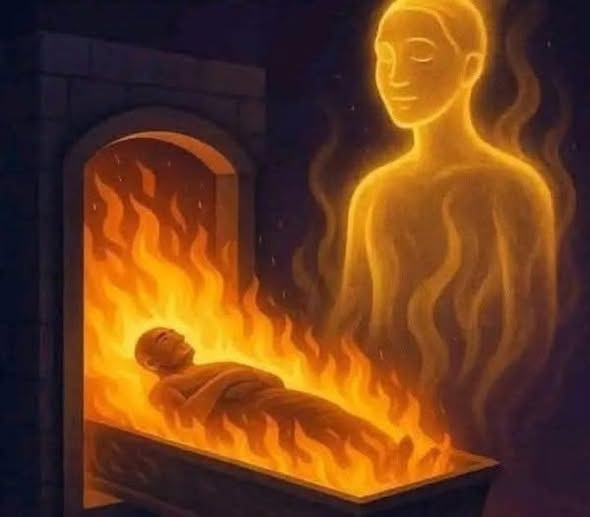
The passing of a loved one often raises deep spiritual questions. One of the most common is: what happens to the soul when the body is cremated?
The answer varies depending on religious beliefs, cultural traditions, and personal philosophies. While the physical process of cremation is well understood, the journey of the soul remains a mystery that different societies have interpreted in many ways for centuries.
Hindu Beliefs
In Hinduism, cremation is the traditional and preferred method for handling the deceased. Followers believe that the soul, known as the atman, is eternal and does not die with the body.
At the moment of death, the soul leaves the physical body. Cremation helps release the soul from its earthly form and allows it to continue its spiritual journey through Samsara, the cycle of birth, death, and rebirth.
Fire holds deep symbolic meaning in Hindu traditions. It is seen as a purifying force that helps separate the soul from the physical body, enabling it to move toward its next existence.
Buddhist Perspective
In Buddhism, cremation is also common. However, the focus is less on an eternal soul and more on the continuation of consciousness.
Buddhists believe that what continues after death is not a permanent soul but a stream of consciousness shaped by Karma. Cremation does not affect this process because the spiritual transition occurs at the moment of death, not during the physical handling of the body.
Christian Views
In Christianity, views on cremation have changed over time. Historically, burial was preferred because of beliefs related to bodily resurrection.
Today, many Christian denominations accept cremation. The soul is believed to leave the body immediately after death and enter the presence of God or await final judgment. Since the soul is spiritual rather than physical, cremation does not affect its destiny.
Islamic Beliefs
In Islam, cremation is generally prohibited. Islamic tradition teaches that the human body should be buried respectfully as soon as possible after death.
Muslims believe that the soul separates from the body at death and enters a stage known as Barzakh, where it remains until the Day of Judgment.
Although cremation is discouraged, the soul itself is considered independent of the body and ultimately accountable to God.
Scientific Perspective
From a scientific standpoint, the soul cannot be measured or observed. Science explains death as the point when biological functions stop and the body begins to break down.
Cremation simply accelerates the natural process of decomposition through intense heat. While science can describe what happens physically, questions about the soul remain within the realm of philosophy and spirituality.
A Shared Understanding
Across many cultures and belief systems, one common idea appears repeatedly: the soul is separate from the physical body.
Whether through burial or cremation, most traditions believe that the spiritual essence of a person continues in some form beyond death. The body may return to nature, but the deeper meaning of life and consciousness remains a profound mystery.