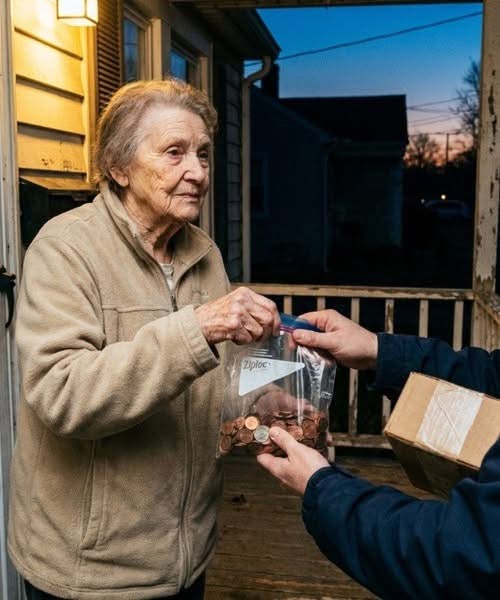
The Bag of Coins
When she handed me the small, crinkly Ziploc bag, the faint metallic clink of coins hitting each other echoed through my hands. The sound was low, heavy—a quiet percussion of pennies, nickels, and dimes, tiny witnesses to her quiet struggle.
“I think this should be enough,” she whispered, her voice trembling slightly, as though the coins could hear her uncertainty and refuse to cooperate.
I looked down at the bag. The total was $14.50. Not even enough to cover a full meal in most places, but every coin clearly mattered to her.
I stood on the worn wooden porch, feeling the winter wind cut through my jacket. The delivery slip had been simple: back door, knock loudly.
The house sat at the edge of town. The paint peeled from the siding. The mailbox leaned to one side. No porch light glowed. No sound came from inside.
I knocked.
“Come in!” a frail voice answered.
The air inside was colder than the winter outside. No television. No radio. Just a single flickering lamp and the uneven rhythm of her breathing.
She sat bundled in quilts, slumped in a recliner that looked decades old.
When she saw the pizza box, her face lit up—not just with hunger, but with relief.
“I try not to turn on the heat until December,” she said apologetically. “I have to save money for my heart medication.”
She handed me the bag of coins.
“I counted everything twice,” she added. “Mostly pennies… a few nickels from the couch.”
I didn’t take it right away. My eyes drifted toward the kitchen.
The refrigerator door wasn’t fully closed. Inside: half a jug of water, a box of baking soda, and a small stapled pharmacy bag.
That was it.
On the mantle were faded photographs. In one, she wore a nurse’s uniform from the 1970s, standing tall and proud.
She had spent decades caring for others. Now she was choosing between heat, medication, or food.
“Actually,” I said, forcing a smile, “our system glitched. You’re our hundredth customer today. Your pizza is on the house.”
Her brow furrowed. “You won’t get in trouble?”
“I’m the manager,” I lied. “Keep the change.”
Steam rose from the box as I placed it on her lap. She closed her eyes and inhaled deeply. A tear slid down her cheek.
The Morning After
The next morning my phone lit up with missed calls. Darren, the manager.
Inventory was off. Cameras showed my delay, my return with groceries.
“You can’t just give things away,” he said. “It’s not your money.”
“She didn’t have food,” I replied.
“That’s not our responsibility.”
There it was. The dividing line.
He told me I would need to pay for the order and sign a disciplinary write-up.
I refused.
I walked out unemployed.
Returning
I went back the next evening.
She had turned the heat down again.
“The bill scares me,” she whispered.
She had eaten half a banana. Half.
I found her son’s number and called him. He arrived defensive and suspicious—until he opened the fridge.
Silence.
“She didn’t tell me it was this bad,” he said.
“She didn’t want to bother you.”
Then he asked quietly, “You lose your job over this?”
“Yes.”
The Internet Weighs In
Later, someone posted a photo of her handwritten note online:
“To the young man who brought me dinner—thank you for seeing me.”
Comments exploded. Some praised compassion. Others said she should budget better. Some said I was reckless. Others defended the manager.
Was it wrong? Was it irresponsible? Or simply human?
Then my phone rang again. An official voice:
“We received a welfare report about the elderly resident at that address. Are you the one visiting?”
It wasn’t just an argument anymore.
It was the system knocking.
And this time, it wasn’t asking politely.