Posted on March 3, 2026
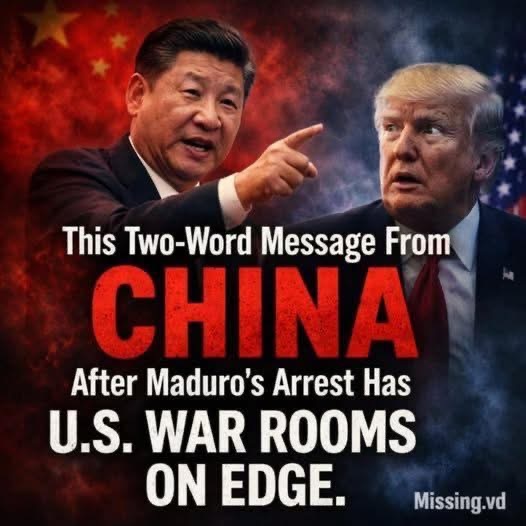
For several tense hours, Washington’s steady political rhythm slowed to an unusual hush. Public briefings were quietly postponed. Official calendars shifted without explanation. Senior officials stepped away from public appearances and into secure rooms. The disruption was not triggered by a missile test or a cyberattack. Instead, it followed a discreet diplomatic communication reportedly delivered from Beijing.
The message was brief. Its contents were not publicly disclosed. Yet within U.S. national security circles, it was interpreted as a calculated signal tied to rising tensions over Venezuela.
At the center of the geopolitical calculation stands Nicolás Maduro, Venezuela’s long-serving president. According to circulating assessments, Washington had been reviewing options to increase pressure on Maduro’s government. These reportedly included tighter sanctions enforcement, expanded legal coordination with allies, and broader diplomatic efforts aimed at reshaping Venezuela’s political trajectory.
On the surface, such measures appear focused on governance and human rights concerns inside Venezuela. In strategic terms, however, the implications extend far beyond Caracas.
Over the past two decades, China has invested heavily in Venezuela through oil-backed loans, infrastructure financing, energy joint ventures, and telecommunications projects. Chinese state-linked institutions have provided tens of billions of dollars in credit arrangements tied to oil exports. Chinese firms maintain involvement in energy production, construction, and technology sectors across the country.
For Beijing, Venezuela represents more than a troubled economy. It is a strategic foothold in the Western Hemisphere—an arena historically shaped by U.S. influence. Long-term agreements embed Chinese interests into Venezuela’s oil output and debt structures. A sudden political shift could introduce uncertainty into these arrangements, potentially affecting repayment mechanisms and contractual stability.
From Beijing’s perspective, aggressive external efforts to remove or weaken Maduro could therefore be interpreted not only as a domestic Venezuelan matter but as a move with broader strategic implications.
This wider context appears to have reframed internal discussions in Washington. Analysts reportedly examined Venezuela not solely as a regional challenge but as a node within the larger U.S.–China strategic rivalry. The concern was not necessarily direct confrontation in Latin America, but the possibility of indirect signaling elsewhere.
Attention naturally turns to the South China Sea, where U.S. and Chinese forces have long operated in close proximity. China has expanded artificial islands and military infrastructure in contested waters, while the United States conducts freedom-of-navigation operations to assert international maritime norms. The region remains one of the most sensitive flashpoints in global security dynamics.
Strategic history suggests that major powers sometimes respond to pressure in one theater by adjusting posture in another. Such moves can serve as calibrated signals without escalating into direct conflict. In that light, any developments in Venezuela could ripple outward into unrelated but strategically significant regions.
The episode highlights how global power competition increasingly intersects with economic networks. Unlike Cold War-era rivalries defined largely by military blocs, today’s competition is woven through investment flows, energy contracts, trade relationships, and technology partnerships. Influence is often embedded quietly in infrastructure and finance rather than projected overtly through military deployments.
For Venezuela, this creates a layered reality. Domestic political developments unfold within a matrix shaped by external stakeholders. Decisions in Washington and Beijing influence economic stability, debt sustainability, and diplomatic space. The country’s internal crisis is therefore linked to broader currents of global competition.
For the United States, the situation illustrates the complexity of contemporary statecraft. Policy actions aimed at advancing democratic governance or enforcing sanctions must now be evaluated within a wider strategic ecosystem. Moves taken in Latin America may generate reactions in Asia-Pacific theaters or other areas where U.S. and Chinese interests intersect.
For China, the moment reflects a pattern of protecting overseas investments through measured signaling rather than overt confrontation. Beijing has consistently emphasized principles of sovereignty and non-interference while simultaneously deepening economic engagement abroad. Its approach in Venezuela aligns with a long-term strategy of embedding influence through financial and industrial integration.
Publicly, both sides have maintained relative restraint. There have been no dramatic statements announcing a crisis. Yet the quiet recalibration behind the scenes underscores the interconnected nature of modern geopolitics.
The broader lesson is that regional crises rarely remain regional. Energy markets, shipping routes, and global supply chains link distant theaters. Strategic competition unfolds across multiple domains simultaneously—economic, diplomatic, technological, and military.
Venezuela now stands at a crossroads shaped not only by its internal challenges but by the calculations of major powers navigating a more competitive international environment. Whether tensions ease or intensify will depend on how carefully each actor manages signaling, restraint, and long-term objectives.
In today’s strategic landscape, even brief communications can carry substantial weight. The interplay between Washington, Beijing, and Caracas serves as a reminder that global influence is often exercised subtly—but its consequences can be far-reaching.