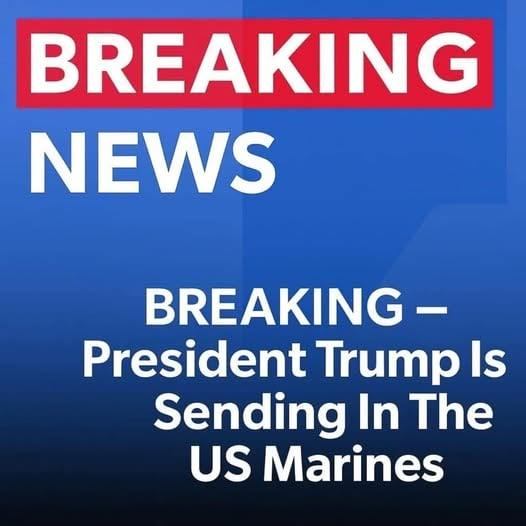
The United States military has formally acknowledged the deployment of approximately 200 U.S. Marines to Florida in support of Immigration and Customs Enforcement (ICE). While officials emphasize that the Marines will serve strictly in logistical and administrative roles—not in law enforcement or combat—the decision has sparked national debate over the appropriate role of the military in domestic affairs.
Purpose of the Deployment
According to statements from the Department of Defense (DoD), the Marines are being deployed to assist with clerical and logistical tasks, including:
- Processing documentation
- Managing records and data entry
- Coordinating transportation logistics
- Supporting facility operations
Officials state that the move is intended to relieve administrative backlogs within ICE operations, particularly as Florida faces increased pressure from higher volumes of migrant processing.
Military leaders have stressed that the deployment falls within legally permissible forms of domestic military support and does not involve arrests, detentions, or enforcement authority.
Legal and Constitutional Considerations
The deployment has prompted renewed discussion about the Posse Comitatus Act, which restricts federal military involvement in domestic law enforcement activities. While the law allows certain exceptions—particularly for support roles—critics argue that the spirit of civilian-military separation could be weakened if such deployments become more common.
Civil rights advocates and legal scholars have expressed concern that even administrative military presence in immigration facilities may carry symbolic implications. They warn that the normalization of uniformed service members in civilian enforcement environments could gradually shift public expectations regarding the military’s domestic role.
Supporters’ Perspective
Supporters of the deployment frame it as a practical and temporary response to operational strain. ICE has reportedly faced staffing shortages and administrative bottlenecks linked to rising case volumes. Proponents argue that assigning non-enforcement tasks to trained military personnel allows ICE agents to focus on their core responsibilities.
Advocates also note that the military has historically provided domestic assistance during natural disasters, public health emergencies, and infrastructure crises. From this viewpoint, the Florida deployment reflects interagency cooperation rather than a shift toward militarized immigration enforcement.
The Department of Defense has stated that all participating Marines will receive specialized orientation to ensure compliance with federal law and respect for constitutional protections.
Political and Community Reaction
Public response in Florida has been mixed. Some state and local officials have welcomed the additional support, citing the need for efficient processing and orderly operations. Others have raised concerns about optics and community perception, particularly given the highly charged political climate surrounding immigration policy.
Immigration advocacy organizations have called for transparency and independent oversight, emphasizing the importance of protecting due process rights and maintaining clear boundaries between administrative support and enforcement actions.
Community leaders have similarly expressed divided views. Some argue that improved administrative efficiency benefits both migrants and host communities by reducing delays. Others worry that the presence of Marines could contribute to narratives framing migration primarily as a security issue.
Broader Policy Implications
Beyond Florida, the deployment raises larger questions about civil-military relations and long-term immigration policy reform. Analysts note that while current law permits certain forms of domestic military support, the visibility and frequency of such actions shape public norms and institutional boundaries.
Some policy experts argue that reliance on military assistance highlights structural challenges within civilian immigration agencies, including staffing shortages and outdated systems. They contend that sustainable reform should focus on strengthening civilian infrastructure rather than turning to the military for interim solutions.
ICE officials maintain that the deployment is temporary and narrowly defined. Marines are expected to withdraw once administrative pressures ease and operational stability improves.
Ongoing Oversight and Evaluation
Federal authorities have indicated that the deployment will be continuously assessed for:
- Operational efficiency
- Legal compliance
- Protection of civil liberties
- Interagency coordination effectiveness
Lessons learned from this initiative may inform future decisions regarding military support in domestic logistical roles.
A Defining Moment in Governance Debate
The Florida Marine deployment reflects broader tensions in U.S. governance between efficiency, security, and civil liberties. Immigration policy occupies a particularly sensitive intersection of these concerns, and the involvement of the military—even in a limited capacity—intensifies longstanding debates about institutional boundaries.
Whether viewed as a pragmatic solution or a troubling precedent, the initiative underscores the importance of transparency, oversight, and public dialogue. The outcome may shape future approaches to immigration management and influence public trust in both enforcement agencies and the armed forces.
As developments continue, attention will remain focused not only on operational outcomes, but also on how this moment contributes to evolving norms around the role of the military within civilian life in a democratic society.