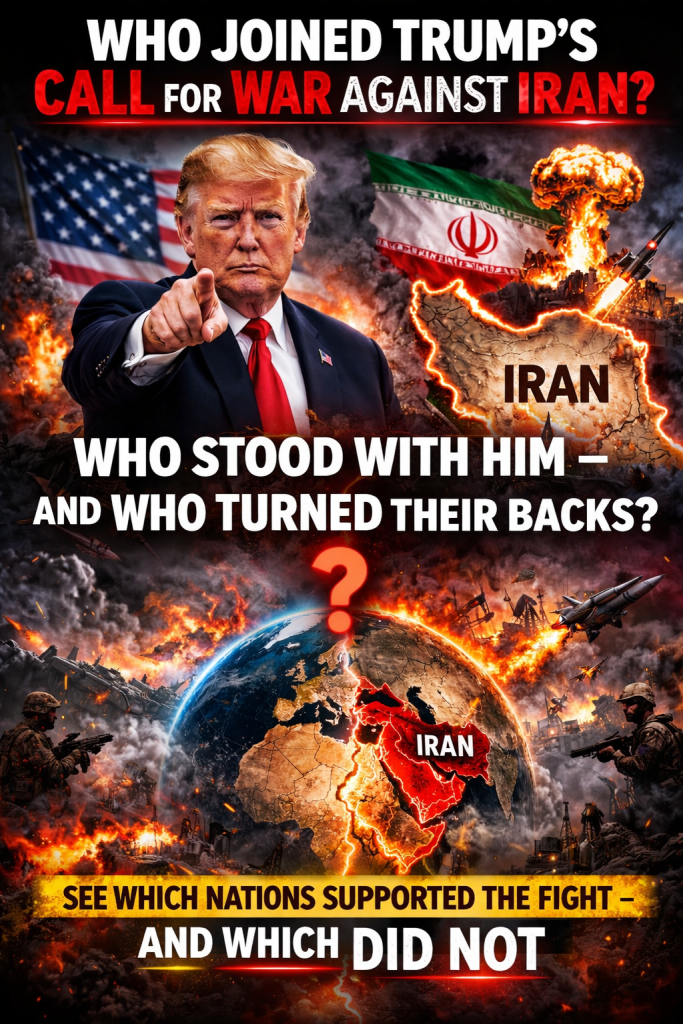
The world is once again standing at the edge of a geopolitical storm. After renewed tensions between the United States and Iran, former U.S. President Donald Trump issued a powerful call for allied nations to stand beside America in a potential confrontation with Iran. The request immediately sent shockwaves through international politics, forcing governments around the globe to make a difficult decision: join the coalition or stay out of the conflict.
What followed was a rapid and revealing global response. Some nations quickly aligned themselves with Washington, offering support or cooperation. Others rejected the idea outright, warning that such a war could destabilize entire regions and push the world toward a much larger crisis.
Nations That Stepped Forward
Several countries responded positively to Trump’s call, signaling their willingness to support the United States in various ways. While not all have committed military forces, many have expressed political backing, logistical assistance, or readiness to cooperate if tensions escalate further.
Among the nations that have shown support are:
- Australia
- Canada
- Germany
- Finland
- Romania
- Lithuania
- Latvia
- Ukraine
- New Zealand
- Argentina
- Kosovo
- Albania
These nations, many of them long-time allies of the United States, emphasized the importance of maintaining stability in the Middle East and protecting global security interests. For some governments, the decision was also about maintaining strong strategic partnerships with Washington.
Supporters argue that confronting Iran’s regional influence and military activities is necessary to prevent larger conflicts in the future. Others say cooperation with the United States is essential for preserving international security alliances.
Countries That Refused to Join
However, not every nation was willing to follow Washington into another potential war in the Middle East. A number of powerful and influential countries openly rejected the invitation, urging diplomacy instead of confrontation.
Among the nations that declined participation are:
Many of these governments warned that escalating military action against Iran could ignite a wider regional war, potentially drawing multiple global powers into direct confrontation.
Both Russia and China voiced particularly strong opposition, emphasizing that diplomacy and negotiations should be the only path forward.
The Silent and the Undecided
Adding even more uncertainty to the situation are several major global powers that have not fully committed to either side.
Countries like United Kingdom, France, Japan, and South Korea have taken a cautious stance. Their leaders have expressed concern about rising tensions but have avoided making definitive commitments about military involvement.
Instead, many of these nations are focusing on protecting shipping routes, securing trade corridors, and encouraging diplomatic dialogue.
A World Divided
Trump’s call for an international coalition has revealed deep divisions in global politics. While some governments believe strong action against Iran is necessary, others fear that another large-scale conflict in the Middle East could destabilize global markets, disrupt energy supplies, and push already fragile international relations toward crisis.
For now, the world watches closely as alliances form, diplomatic pressure grows, and governments weigh the consequences of their decisions.
Whether this moment becomes the beginning of a larger confrontation or a turning point toward renewed diplomacy remains uncertain. But one thing is clear: the choices nations make today could shape global stability for years to come.