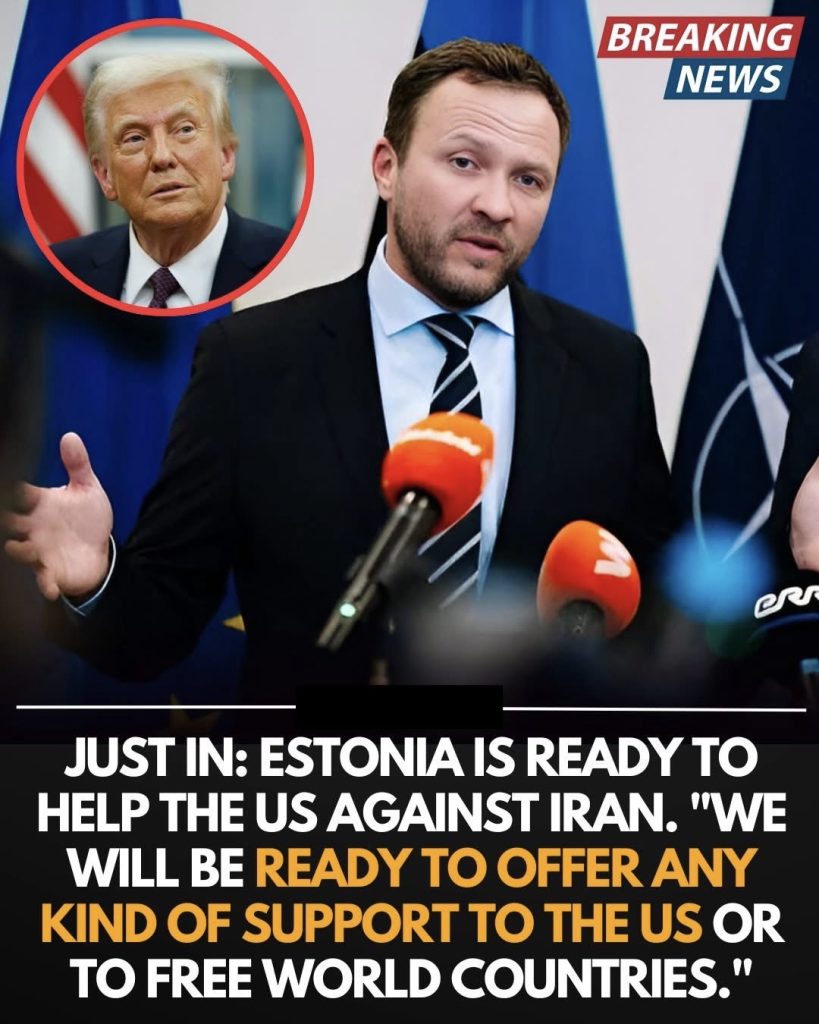
In a move that is rapidly gaining global attention, Estonia has officially declared its readiness to provide “any kind of support” to the United States and its allies, at a time when divisions inside NATO appear to be widening.
The announcement comes as Washington faces increasing hesitation from key partners such as Germany and Canada over the escalating conflict tied to what officials have referred to as Operation Epic Fury.
A Small Nation, A Strong Signal
Estonian officials framed their decision as a stand in defense of the “free world” and the rules-based international order.
Despite its relatively small military size, Estonia’s move carries strategic weight. By stepping forward, Tallinn is positioning itself as one of the most reliable partners of the U.S. during a period of growing geopolitical fragmentation.
This is not just about military capability—it’s about political signaling.
A Coalition Begins to Form?
As Operation Epic Fury enters a more complex and uncertain phase, Estonia’s commitment suggests the early formation of what analysts describe as a “coalition of the willing.”
While several major European powers remain cautious, smaller nations may now begin to:
- Align more closely with Washington
- Increase logistical and intelligence cooperation
- Step into roles previously dominated by larger NATO members
If this trend continues, it could reshape internal dynamics within NATO.
A Boost for
The move represents a clear diplomatic win for President Donald Trump, who has recently criticized major allies for what he described as a lack of meaningful support.
In particular, Trump highlighted the failure of some countries to provide even basic naval resources such as minesweepers during a critical phase of maritime instability.
The White House responded positively to Estonia’s decision, emphasizing that:
“True partners step forward in times of crisis.”
Rising Tensions with
and
Not everyone sees Estonia’s move as stabilizing.
Officials in Moscow and Tehran are expected to strongly criticize the announcement, viewing it as an escalation.
Russian Foreign Minister Sergey Lavrov previously mocked U.S. strategy, claiming that:
“Unprovoked aggression has left Washington isolated and overstretched.”
This highlights the growing information war alongside the military and diplomatic tensions.
Strait of Hormuz Near Breaking Point
The timing of Estonia’s support is critical.
The situation in the Strait of Hormuz is deteriorating rapidly:
- Tankers have been attacked
- Shipping routes are disrupted
- Global energy markets are under pressure
With maritime security under threat, even limited support—logistical, cyber, or intelligence—can make a significant difference.
What Happens Next?
All eyes are now on other Eastern European and Baltic states.
Will they follow Estonia’s lead?
If more countries step forward, the result could be:
- A reconfiguration of NATO’s internal power balance
- Stronger regional blocs within the alliance
- Increased polarization between global powers
Final Analysis
Estonia’s move may seem small on the surface—but strategically, it could mark the beginning of a larger shift.
In times of uncertainty, alliances are tested not by size—but by willingness to act.
And right now, Estonia has made its position clear.