Trust is the unseen framework of a relationship, a silent scaffolding that bears weight without ever demanding attention. Like the roots of a tree or the beams of a building hidden behind walls, trust quietly supports everything we rely on, keeping life steady and safe. Most of the time, we take it for granted—until a single, unexpected fracture makes the entire structure feel unstable. I never imagined that an ordinary afternoon on a quiet trail would reveal such a fracture in my marriage, challenging assumptions I had never thought to question.
Horseback riding has always been my sanctuary. There is a meditative rhythm in the sway of a horse beneath you, the steady beat of hooves against the earth, and the gentle rustle of leaves overhead. On that particular day, the forest seemed sacred, the air crisp and fragrant with pine and damp soil. Dust motes floated in sunlight, and a faint breeze brushed my face. It was a place where the world falls away, leaving only the connection between you and the animal beneath you. I breathed deeply, savoring the stillness.
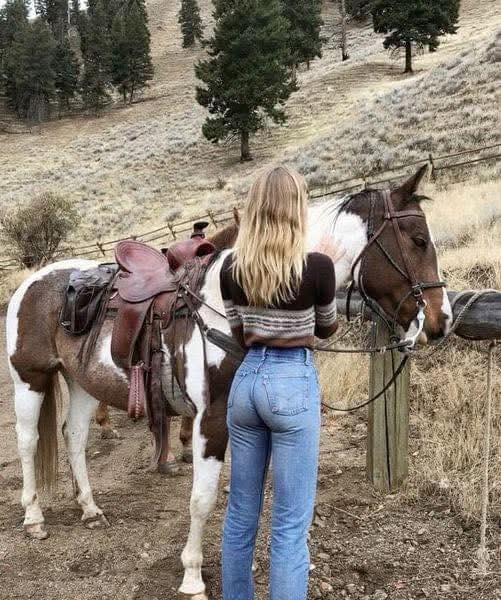
I was riding a borrowed mare, gentle and patient. The trail curved softly through ferns and mossy rocks. Lifting my phone to capture the scene, I noticed faint initials carved into the leather of the saddle near my leg. Weathered and easy to overlook, they belonged to a previous owner. I thought nothing of them and sent the photo to my husband—a simple digital postcard: “Thinking of you.”
The reply I received was clipped, cold, distant. The warmth I expected was gone. Another message went unanswered, leaving a vacuum where comfort once lived. Even across miles, the tension was palpable. When I returned home, the atmosphere had grown heavy. My husband moved with cautious grace, his usual warmth replaced by brittle quiet. Eventually, he asked about the photo—not the trail, sunlight, or horse, but the saddle. Whose initials were carved there, and why had I never mentioned them? His voice carried a quiet apprehension, not anger.
At first, I felt defensive. How could a minor mark provoke such a reaction? But looking into his eyes, I saw fear. Those initials were more than etchings; they were a portal into a past he feared he might never fully understand. In that moment, I realized marriage—even after years together—is never insulated from uncertainty.
We chose to stay present and speak openly. That conversation wasn’t about a saddle—it was about the unspoken corners of our relationship. We shared memories, fears, insecurities, and patterns of silence that had created shadows where misunderstandings thrived. Hours passed as we navigated the messy terrain of honesty and vulnerability. We acknowledged that love is living and requires attention, care, and courage.
By the end of the night, the initials remained—but they no longer stood as a barrier between us. We committed to a principle: whenever doubt or unease arises, we would speak immediately, openly, without letting assumptions fester. My husband later told me that my willingness to listen mattered more than any explanation. What he feared wasn’t my past, but the possibility of hidden corners in my life from which he was excluded. In that openness, the fear dissolved.
Reflecting on that day, I am profoundly grateful. A quiet ride through the forest, a snapshot of the trail, could have triggered distance and silence—but instead, it deepened our connection. Love thrives in quiet moments of discomfort, in the courage to sit with someone else’s fears until light returns. It is found in witnessing vulnerability and remaining present when uncertainty arises.
Since then, I see our marriage differently. Every relationship has its silent scaffolding, the hidden supports of trust and understanding. Openness is not optional—it is essential. The small, everyday gestures, the willingness to address shadows, and the choice to stay in dialogue are what sustain love over time.
When I look at that photo now, I do not merely see a trail, sunlight through the leaves, or a borrowed horse. I see the day we confronted unspoken fears, chose communication over assumption, and recommitted to each other, initials and all. Trust is the silent architecture of love. Sometimes, it takes a small crack—a photograph, a moment of doubt, a pair of carved initials—to remind us of how fragile it is, and how profoundly it can be strengthened through presence, honesty, and empathy.