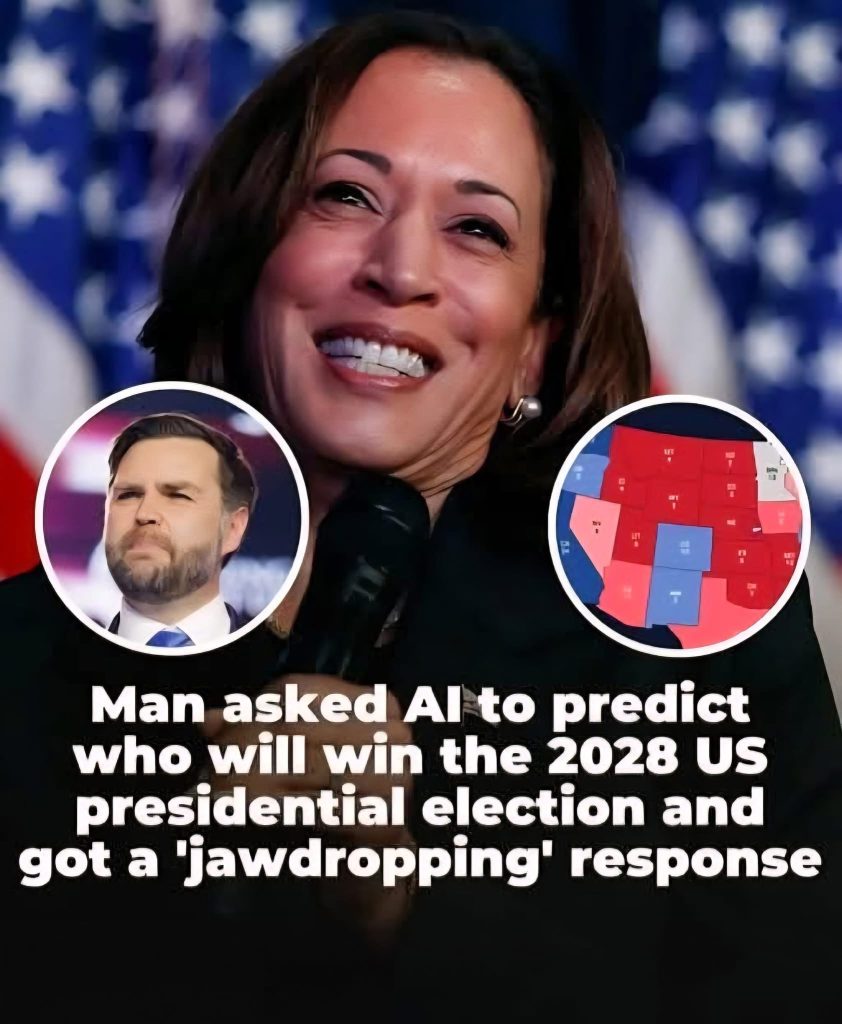
A viral “AI forecast” has been circulating widely because it does something people naturally look for—it picks a winner for the 2028 U.S. presidential election and presents a clean Electoral College map.
The YouTube channel Election Time asked Grok, the chatbot developed by Elon Musk, to simulate a potential election scenario. According to summaries of that video, the model predicts a Republican victory, with the decisive margin coming from a small number of swing states.
Grok’s Prediction
In the simulated matchup, Grok forecasts that JD Vance defeats Kamala Harris with a projected Electoral College result of 326–212.
The model reportedly assumes that Vance would retain all states won by Donald Trump in 2024, while flipping Minnesota and New Hampshire—two states often considered competitive.
This creates a narrative not just of a win, but of an expanded Republican map. However, this remains a hypothetical scenario, not a prediction based on real campaign data.
How the Forecast Was Built
The simulation depends heavily on:
- Pre-selected candidates
- Recent voting patterns
- Early polling signals
- General political assumptions
AI models like Grok do not conduct surveys or gather new data. Instead, they generate outputs based on existing information and patterns. This means the result reflects the inputs and framing, not a real-world forecast.
The “Safe States” Approach
Like many human analysts, the model starts with a familiar electoral map:
- Democratic strongholds (e.g., California, Washington, parts of New England)
- Republican strongholds (e.g., Oklahoma, Kansas, Idaho)
It then focuses on a few swing states to determine the outcome.
The key claim in this scenario is that the battleground shifts toward:
- The Midwest
- Parts of New England
This is what supports the projected flips in Minnesota and New Hampshire—but without detailed explanation of why voters would shift.
Why Early Predictions Are Weak
Forecasts this early (2026 for a 2028 election) are highly unreliable because:
- Candidates may not even run
- Campaign dynamics are unknown
- Economic conditions can change
- Major events can reshape voter behavior
Early polling often reflects name recognition, not actual voter decisions.
The Constitutional Reality
Any 2028 scenario must follow the rules of the Twenty-Second Amendment, which limits presidents to two terms. This ensures that entirely new candidates will compete, making the race more unpredictable.
Bottom Line
Grok’s prediction is not a real forecast—it’s a simulated scenario based on assumptions.
What it tells us:
- It imagines a Vance vs. Harris matchup
- It predicts a clear Republican win (326–212)
- It suggests key flips in Minnesota and New Hampshire
What it does not tell us:
- Who will actually run
- How voters will behave
- What events will shape the election