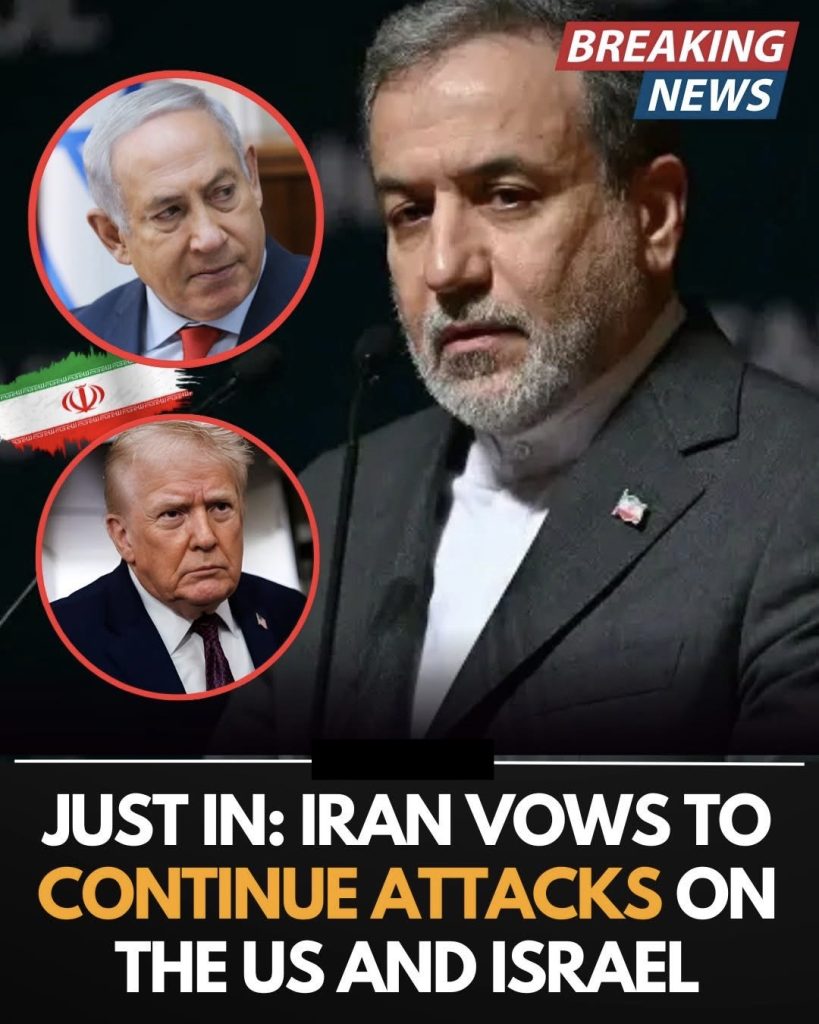
Tensions in the Middle East have surged dramatically after Tehran issued a defiant declaration promising to sustain—and potentially intensify—military operations against both the United States and Israel. The announcement comes in the wake of a large-scale wave of coordinated airstrikes that reportedly targeted key Islamic Revolutionary Guard Corps (IRGC) command centers and ballistic missile production facilities across Iran.
Iranian officials described the attacks as a direct attempt to weaken the country’s strategic capabilities, but insisted that the strikes have had the opposite effect. According to state-aligned statements, the so-called “decapitation” of leadership elements has only strengthened national resolve, with leaders emphasizing that Iran is “far from yielding” to external pressure or proposed de-escalation terms.
This firm stance has effectively stalled recent diplomatic efforts aimed at securing a maritime truce in the region—particularly around the strategically critical Strait of Hormuz. Instead of signaling compromise, Tehran’s rhetoric points toward a prolonged confrontation, raising concerns among global powers about the potential for a wider regional war.
The situation is further complicated by reports of a significant U.S. military buildup. Thousands of American Marines are believed to be en route to the Persian Gulf, reinforcing speculation that Washington is preparing for a broader range of operational scenarios. Among the most discussed possibilities are contingency plans involving key strategic assets, including Kharg Island—an essential hub for Iran’s oil exports.
Iran has responded directly to these developments, warning that any attempt at ground operations or territorial control will be met with “total resistance.” Military analysts suggest that such statements are designed not only to deter immediate action but also to signal readiness for asymmetric warfare, including missile strikes and proxy engagements across the region.
Meanwhile, what some observers are calling a renewed “war of the cities” appears to be taking shape. This phase of conflict typically involves strikes targeting infrastructure, urban areas, or symbolic locations, increasing both the human and psychological toll of the confrontation. While details remain fluid, the risk of escalation into densely populated zones has raised alarms among humanitarian organizations and international observers.
Beyond the battlefield, the economic consequences are already being felt worldwide. The Strait of Hormuz—through which roughly one-fifth of global oil supply passes—remains under constant threat. Market reactions have been swift and severe, with oil prices surging toward the $180 per barrel mark in some forecasts. This volatility is forcing governments and industries to prepare for potential long-term disruptions in energy supply chains.
Countries heavily dependent on imported energy are particularly vulnerable, with analysts warning of inflation spikes, supply shortages, and broader economic instability if the situation continues to deteriorate. Financial markets have also reacted nervously, reflecting uncertainty about how far the conflict could spread and how long it might last.
The international community now finds itself at a critical juncture. While diplomatic channels remain open in theory, the increasingly hardened positions on both sides make immediate de-escalation unlikely. Attention is now turning toward Iran’s next move, with experts anticipating possible retaliation in the form of coordinated missile or drone strikes against coalition bases or strategic urban targets.
As events continue to unfold, one thing is becoming increasingly clear: the path to resolution is narrowing. With both sides entrenched and military assets mobilizing at an unprecedented scale, the region is bracing for what could become a prolonged and high-intensity conflict—one with far-reaching consequences not only for the Middle East, but for the global order as a whole.