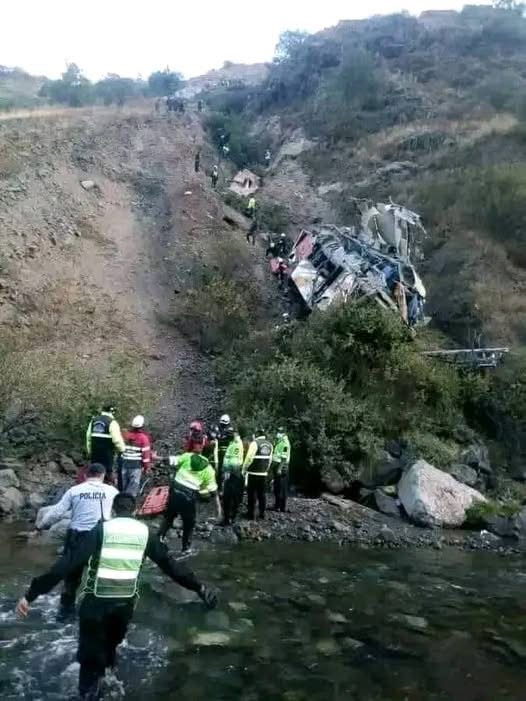
A deadly bus crash in central Peru has claimed at least 33 lives, with nearly 20 others injured, after a passenger bus veered off a mountain highway and plunged into a deep chasm while traveling toward the capital, Lima.
The crash occurred early Tuesday morning as a León Express bus was making its way from Huánuco, in Peru’s central jungle region, to Lima. Authorities said the accident happened near kilometer 72 of the Central Highway, a vital but notoriously dangerous route that cuts through steep mountainous terrain.
Initial investigations suggest the bus struck part of a hillside before losing control and falling into a ravine estimated to be over 100 meters deep. The wreckage stopped just a short distance from the Rímac River, narrowly avoiding an even greater catastrophe.
Emergency crews were dispatched immediately, but rescue efforts proved extremely challenging. Police, firefighters, and medical teams had to descend difficult terrain to reach survivors and recover victims. The scene was marked by crushed metal, broken glass, and personal belongings scattered across the ravine.
Authorities first reported 17 deaths, but as search and recovery operations continued throughout the day, the number of fatalities rose sharply. By Tuesday afternoon, officials confirmed that 33 people had lost their lives.
Colonel Manuel Lozana, head of the Highway Police, confirmed the updated toll and said several injured passengers were taken to hospitals in nearby communities and Lima. Some remain in critical condition, suffering from serious injuries.
“This is among the most severe road accidents we’ve seen this year,” Lozana said. “The depth of the ravine and the impact made rescue operations extremely difficult.”
Relatives of passengers gathered at hospitals and near the crash site, anxiously searching for information. Many were seen grieving, holding photos and documents as they waited for news of missing loved ones.
The Central Highway is infamous for its narrow roads, sharp curves, and steep drops, particularly in mountainous sections. Nighttime travel, poor visibility, and driver fatigue often increase the risk of serious accidents.
While the exact cause of the crash has not yet been determined, investigators are examining factors such as possible mechanical failure, speed, driver exhaustion, and road conditions. Authorities are also reviewing vehicle data to better understand what happened moments before the bus lost control.
The Peruvian government has offered condolences to the victims’ families and pledged support for medical care and recovery efforts. Officials have renewed calls for stronger safety regulations, improved road infrastructure, and stricter oversight of long-distance bus services.
As Peru mourns, the tragedy serves as another painful reminder of the dangers that persist on the nation’s highways—roads meant to connect communities, but which too often become scenes of devastating loss.