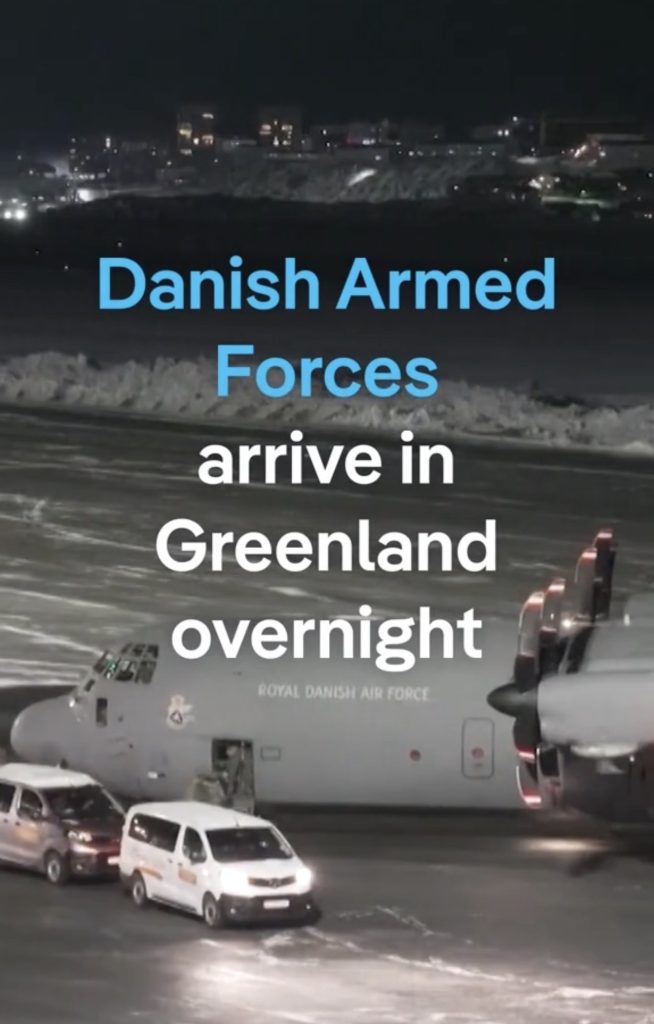
A rare and striking scene unfolded in the far north as a Danish Royal Air Force aircraft touched down at Nuuk Airport in Greenland, carrying military personnel tasked with strengthening security in one of the world’s most strategically sensitive regions. The landing, which took place on January 14, 2026, signals a broader shift in how European nations and NATO are approaching the Arctic—an area once seen as remote, but now viewed as critically important.
According to official statements, the aircraft arrived with Danish military personnel on board, marking a visible escalation in preparedness. Additional troops from several other European countries are expected to arrive soon, reinforcing Danish operations and expanding NATO’s presence in the region. While authorities describe the move as precautionary, the timing has drawn widespread attention.
Germany has confirmed that the deployment is part of a NATO reconnaissance mission aimed at countering what it describes as “Russian and Chinese threats” in the Arctic territory. Though no direct confrontation has occurred, analysts say the increased activity reflects growing concerns over influence, resources, and control in the polar north.
The Arctic has rapidly transformed from a frozen frontier into a geopolitical hotspot. Melting ice has opened new shipping routes and revealed untapped natural resources, making the region more accessible—and more contested—than ever before. Major global powers are now closely watching one another’s moves, and NATO appears determined not to fall behind.
Footage circulating on social media shows uniformed personnel disembarking in cold, harsh conditions, a visual reminder that military readiness extends even to the planet’s most extreme environments. The images have fueled debate online, with some viewers expressing concern about escalation, while others argue that a strong presence is necessary to deter potential aggression.
Officials stress that the mission is defensive in nature. The goal, they say, is surveillance, intelligence gathering, and ensuring stability rather than provoking conflict. Still, the involvement of multiple European countries suggests a coordinated effort that goes beyond routine patrols.
Greenland’s location makes it uniquely valuable. Sitting between North America and Europe, it plays a key role in monitoring air and sea routes across the Arctic. Any shift in control or influence could have global consequences, particularly as competition between major powers intensifies.
For local residents, the arrival of foreign troops is both unusual and unsettling. While Greenland has long hosted limited military infrastructure, such a visible buildup is rare. Authorities have sought to reassure the public that daily life will not be disrupted and that all operations are being conducted with respect for local communities.
As global attention increasingly turns northward, this deployment may be a sign of what’s to come. The Arctic is no longer just ice and isolation—it is a stage where future power dynamics may be decided. Whether this show of force succeeds in maintaining balance or leads to further tension remains to be seen, but one thing is clear: the world is watching the Arctic more closely than ever. https://vt.tiktok.com/ZS5wcPEwb/