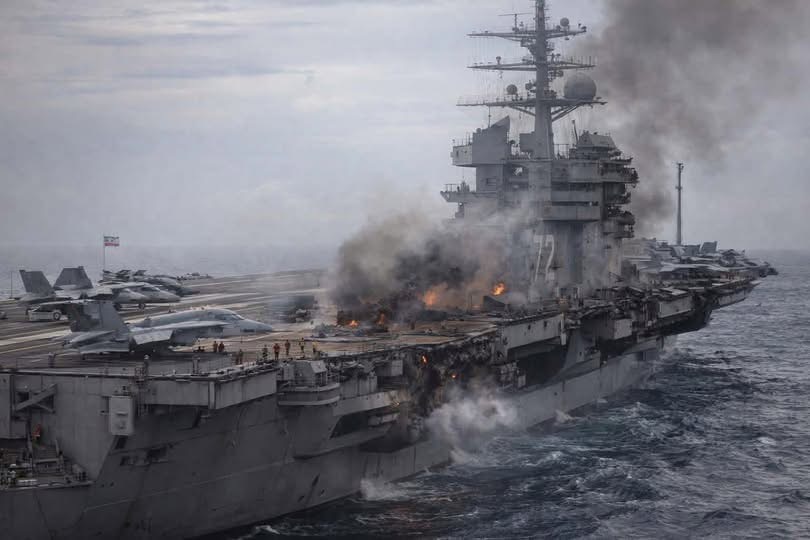
Tensions in the Gulf escalated after Iranian state-linked media outlets claimed that a missile launch targeted a U.S. aircraft carrier operating in regional waters. The reports described the action as retaliatory, occurring amid already heightened military alert levels in the region.
As of now, there is no independent confirmation that any U.S. naval vessel was hit, damaged, or directly engaged. U.S. defense officials have not publicly acknowledged a successful strike, and no verified satellite imagery or third-party military monitoring data has emerged to substantiate the claims.
The absence of confirmation has led analysts to approach the situation cautiously, emphasizing the distinction between reported assertions and verified events.
According to Iranian-affiliated sources, the alleged launch was framed as deliberate signaling connected to broader regional developments involving the United States and Israel. The narrative suggested the action was intended to demonstrate capability and resolve rather than necessarily inflict damage.
Without corroboration, however, the claim remains unverified.
Aircraft carriers represent some of the most powerful maritime assets in modern military fleets. They function as mobile airbases capable of launching combat aircraft, coordinating reconnaissance missions, and projecting force across vast distances. Because of their layered defenses, escort vessels, and advanced interception systems, confirmed attacks on such platforms are exceedingly rare.
Even an attempted strike—if confirmed—would carry significant strategic and symbolic implications. Carriers are not only military tools but also visible representations of deterrence and geopolitical presence. Claims of engagement can therefore carry psychological and diplomatic weight, regardless of physical impact.
The broader regional atmosphere has been tense. Naval patrols and aerial surveillance operations have reportedly increased across parts of the Gulf. In environments where rival forces operate in proximity, analysts note that miscalculations can occur quickly. For that reason, military professionals typically rely on established communication channels to reduce escalation risks.
Experts in strategic communications also point out that early reports during geopolitical crises may serve signaling purposes. State-linked media outlets can act as instruments of national messaging, shaping perception domestically and internationally. This does not automatically invalidate claims, but it underscores the need for independent verification before drawing conclusions.
Financial markets reacted quickly to the reports. Energy prices showed volatility as traders assessed potential risks to shipping lanes in one of the world’s most critical oil transit corridors. Insurance firms and shipping operators also monitored developments closely, aware that even perceived instability can influence operational costs.
Analysts have outlined several possible scenarios: a missile launch intercepted before reaching its target, a demonstration launch intended as a show of capability, a rhetorical claim designed for strategic messaging, or a delayed confirmation pending official review. Each carries different implications, but none can be treated as definitive without evidence.
It is also common for governments to delay public statements during sensitive military situations. Operational security, personnel safety, and coordination with allies can influence the timing of disclosures. As such, the lack of immediate confirmation neither proves nor disproves the claim.
Historically, naval standoffs have served as flashpoints in international tensions, yet many have been resolved through quiet diplomatic channels rather than open conflict. Maritime signaling often aims to demonstrate readiness without crossing into direct confrontation.
At present, the reported strike remains an unverified claim. Defense ministries, satellite monitoring organizations, and independent journalists are likely to play key roles in clarifying what, if anything, occurred.
Until credible confirmation emerges, the situation stands as a reminder of how rapidly geopolitical tensions can intensify—and how critical careful verification remains in moments of uncertainty.