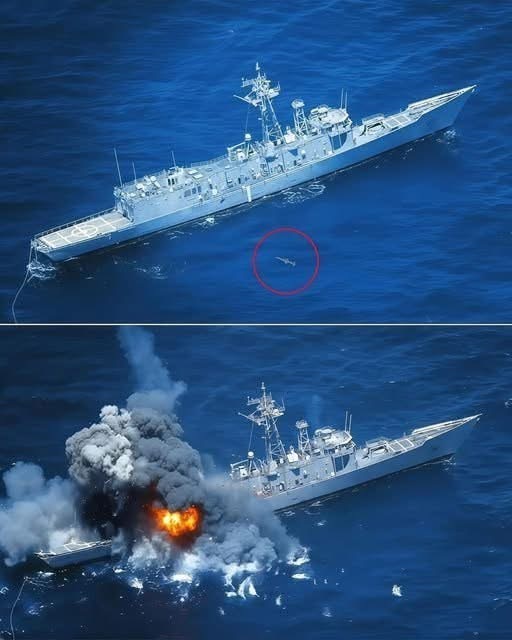
The former USS Rodney M. Davis (FFG-60) served for decades as a guided-missile frigate in the United States Navy before concluding its operational life in a carefully planned sinking exercise. Rather than being lost in combat, the vessel was intentionally sunk during a SINKEX (sinking exercise) after being struck by an AGM-84 Harpoon anti-ship missile. The event marked the final chapter of a long and distinguished career and was conducted under strict environmental, safety, and regulatory standards.
Origins and Commissioning
Commissioned in 1982, USS Rodney M. Davis belonged to the Oliver Hazard Perry-class frigates, a series of warships developed during the Cold War to address evolving maritime threats. Designed primarily for anti-submarine warfare, convoy escort, and fleet support, these frigates played a crucial role in maintaining sea lanes and supporting allied operations during a period of geopolitical tension.
The ship was named in honor of Rodney Maxwell Davis, a United States Marine Corps corporal who was posthumously awarded the Medal of Honor for extraordinary heroism during the Vietnam War. The naming tradition reflects the Navy’s practice of commemorating service members whose courage and sacrifice embody the values of dedication and duty.
Operational Service
Throughout its decades of service, USS Rodney M. Davis deployed across multiple regions, participating in maritime security operations, multinational exercises, counter-piracy patrols, and escort missions. As part of carrier strike groups and independent surface action groups, the frigate contributed to collective defense initiatives and international cooperation.
During the Cold War, anti-submarine warfare capabilities were central to the ship’s design. Equipped with sonar systems, embarked helicopters, and defensive weaponry, the class was structured to detect and deter submarine threats while retaining flexibility for surface and limited air defense tasks.
Following the Cold War, the vessel adapted to shifting strategic priorities. Its missions expanded to include maritime interdiction, humanitarian assistance support, and partnership-building exercises with allied navies. These activities reflected the Navy’s broader emphasis on deterrence, presence, and cooperative security.
Decommissioning and Final Disposition
After decades of active service, USS Rodney M. Davis was decommissioned, formally retiring from operational status. Decommissioning ceremonies traditionally honor the ship’s history and the sailors who served aboard, marking both closure and transition.
Retired naval vessels typically face one of several outcomes: preservation as museum ships, scrapping, foreign military transfer, or use in training exercises. In this case, the decision was made to utilize the vessel in a SINKEX.
A SINKEX is a controlled naval exercise designed to evaluate weapons performance and provide realistic operational training. These exercises are conducted under tightly regulated conditions and far from commercial shipping routes or populated coastlines.
Environmental and Regulatory Oversight
Before a sinking exercise takes place, extensive environmental remediation is required. Hazardous materials—including fuels, oils, asbestos-containing components, and other pollutants—are removed in accordance with environmental protection standards. Sensitive and classified equipment is also extracted.
These procedures are conducted in coordination with environmental agencies to ensure compliance with domestic and international regulations. Environmental stewardship has become a central component of modern naval operations, and careful preparation minimizes ecological impact.
The SINKEX Event
During its final exercise, USS Rodney M. Davis was struck by an AGM-84 Harpoon missile as part of a structured training scenario. The event was not a combat engagement but a deliberate exercise designed to collect data and evaluate systems performance.
Observers gathered metrics related to structural response and impact effects. Such data assists naval engineers and planners in refining ship survivability measures and improving future vessel design. Studying the controlled sinking of decommissioned ships provides insight into hull integrity, compartmentalization performance, and damage patterns.
Strategic and Educational Significance
Exercises like SINKEX contribute to operational readiness by offering training scenarios that cannot be fully replicated in simulations. They also provide valuable information that supports fleet modernization efforts as older vessels are replaced with newer ships featuring advanced sensors, stealth capabilities, and integrated combat systems.
The Oliver Hazard Perry-class frigates represented a significant chapter in naval history. Designed for cost-efficiency and versatility, they served during a transformative era marked by technological advancement and shifting global dynamics. Many ships of this class were later transferred to allied navies, extending their operational life and strengthening defense partnerships.
Legacy and Reflection
For former crew members, the sinking of a ship often carries emotional weight. Naval service fosters strong bonds between sailors and their vessels. While the ship itself now rests beneath the sea, its legacy endures through the experiences and service of those who served aboard.
From commissioning to decommissioning and final disposition, the life cycle of USS Rodney M. Davis reflects the evolving needs of maritime defense. Its final mission—participation in a controlled SINKEX—contributed to training, analysis, and future preparedness rather than wartime destruction.
Conclusion
USS Rodney M. Davis (FFG-60) concluded its decades-long service through a deliberate and regulated naval training exercise. Commissioned in 1982 as part of the Oliver Hazard Perry-class and named in honor of a Medal of Honor recipient, the ship supported maritime security, allied cooperation, and evolving defense missions throughout its career.
Its controlled sinking during a SINKEX provided analytical data to enhance naval readiness while adhering to strict environmental and safety standards. In this way, the vessel’s final chapter reflected continuity of service—contributing to future fleet development and operational preparedness long after its active deployments had ended.