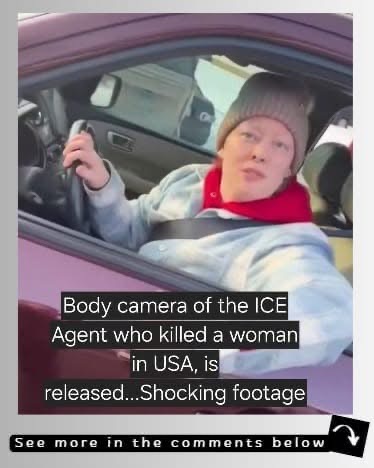
Newly released body camera footage from a U.S. Immigration and Customs Enforcement (ICE) agent has ignited widespread outrage after showing the moments leading up to the fatal shooting of a woman in Minneapolis. The video, which has circulated rapidly online, has intensified national criticism over the use of lethal force by federal immigration officers.
The 47-second recording, first shared by local media and later amplified by senior U.S. officials, captures the encounter from the agent’s viewpoint. In the footage, 37-year-old Renee Nicole Good is seen seated inside her maroon SUV on a quiet residential street. She appears calm, speaking to the agent and at one point saying, “It’s okay, man… I’m not upset with you,” shortly before the situation spirals out of control.
The Department of Homeland Security states that the shooting occurred on January 7, 2026, during a large-scale ICE operation in the Minneapolis area. Federal officials allege that Good attempted to use her vehicle to harm agents, claiming the shooting was an act of self-defense.
That explanation is now being heavily questioned. Video reviewed by multiple news outlets appears to show the SUV moving slowly and turning away from the agent at the moment shots are fired. Local leaders, including Minneapolis Mayor Jacob Frey and Minnesota Governor Tim Walz, have openly challenged the federal version of events, accusing ICE of excessive and unjustified force and dismissing the official account as misleading.
The agent involved has been identified as Jonathan E. Ross, a decade-long member of ICE’s special response unit. In the footage, he appears to be holding a phone while approaching the vehicle before opening fire. After the shooting, a voice on the recording is heard making a derogatory comment, further fueling public anger.
Good, a U.S. citizen and mother of three, later died at a nearby hospital from gunshot injuries. Her wife, Becca Good, said they had stopped only to watch what was happening in their neighborhood and described the atmosphere as calm before it suddenly turned violent. “We had whistles,” she said. “They had guns,” highlighting what she described as a stark and deadly imbalance of power.