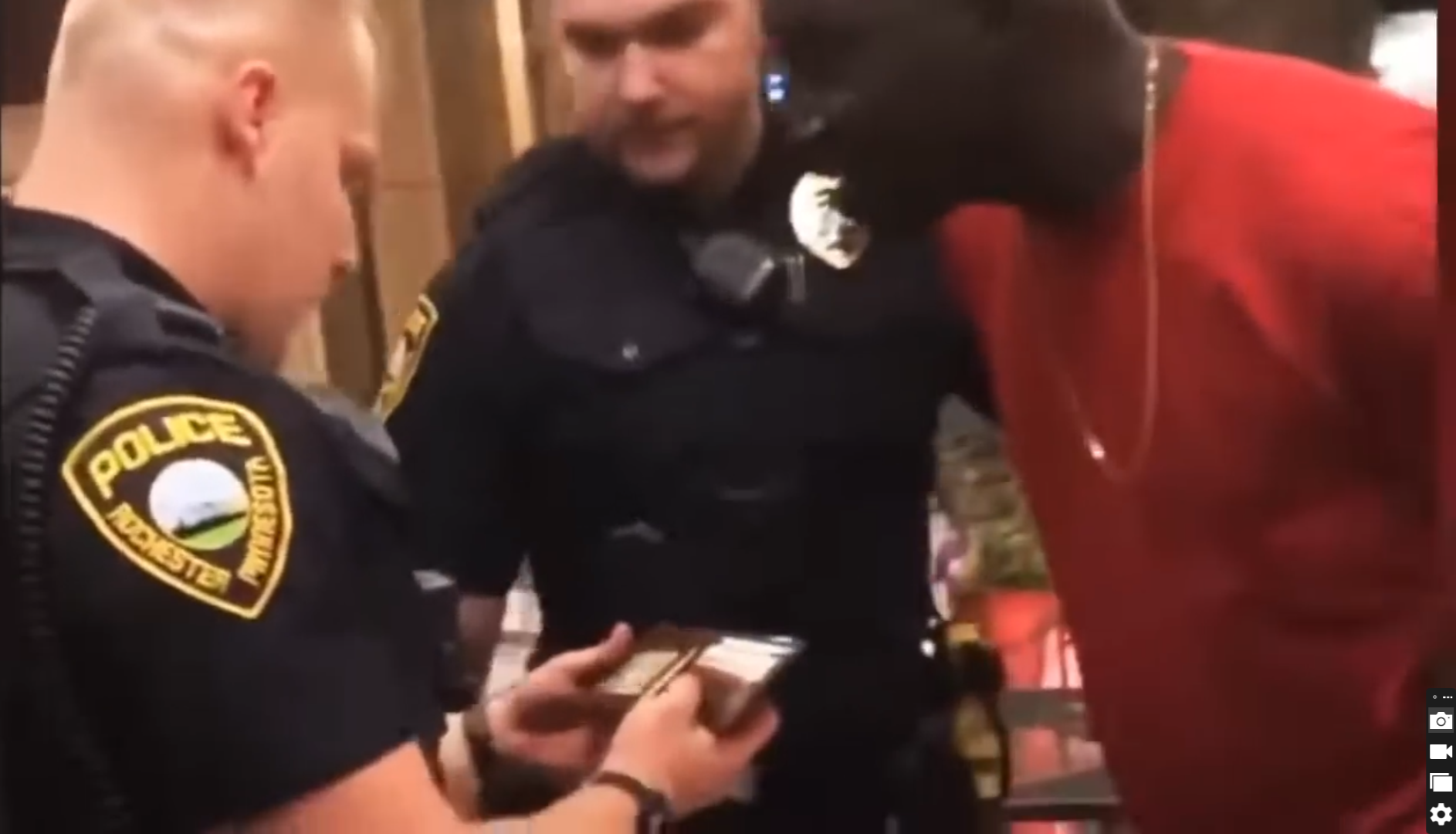
A short but intense video clip circulating online has ignited a storm of debate after allegedly showing police officers stopping and questioning an individual identified by some viewers as an FBI agent. The footage, which appears to be recorded in a public indoor space, captures uniformed officers closely examining a thick stack of cash while a man in a red top stands with his hands raised, surrounded by law enforcement.
The clip has quickly gone viral, with captions claiming it shows police harassment targeting a federal agent. While no official confirmation has been released regarding the individual’s identity, the visual alone has been enough to spark strong reactions across social media platforms. Many viewers describe the encounter as uncomfortable, tense, and unnecessary, while others argue that officers were simply following standard procedures.
In the video, one officer appears to be counting or inspecting a bundle of cash as another officer stands nearby observing the situation. The man in red remains mostly still, seemingly complying with instructions. The presence of multiple officers and the careful handling of the money give the impression that authorities were taking the situation seriously, though the exact reason for the stop remains unclear.
Supporters of the “harassment” claim argue that if the individual truly was a federal agent, the stop raises questions about communication and respect between law enforcement agencies. They suggest that situations like this highlight deeper issues within policing, including excessive suspicion and a lack of coordination. For them, the video symbolizes a power struggle rather than a routine safety check.
On the other hand, critics of that narrative point out that police officers are trained to assess situations based on what they see in the moment, not on claims of status. Carrying a large amount of cash, regardless of profession, can prompt questions, especially in public spaces. From this perspective, the officers’ actions appear methodical and controlled rather than aggressive or abusive.
Experts often caution against drawing conclusions from short clips without full context. Videos shared online rarely include what happened before the recording started or what occurred after it ended. It remains unknown whether the individual provided identification, whether supervisors were involved, or how the interaction ultimately concluded. Without those details, labeling the encounter as harassment—or justifying it entirely—can be misleading.
The discussion surrounding this footage reflects a broader public conversation about policing, authority, and accountability. In recent years, viral videos have played a major role in shaping public opinion, sometimes exposing serious misconduct, and other times oversimplifying complex encounters. Each clip becomes a Rorschach test, interpreted differently depending on viewers’ experiences and beliefs.
What is clear is that this video has struck a nerve. Whether it shows legitimate police procedure or an example of alleged overreach, it has once again placed law enforcement interactions under intense scrutiny. As the clip continues to spread, many are calling for official clarification to determine what truly happened and whether any lines were crossed.
Until more verified information is released, the incident remains a powerful reminder of how quickly perception can turn into controversy—and how a few seconds of footage can fuel a global debate about power, trust, and justice in modern policing.